
 Fast Delivery
  Global Compliance
  Long Term Support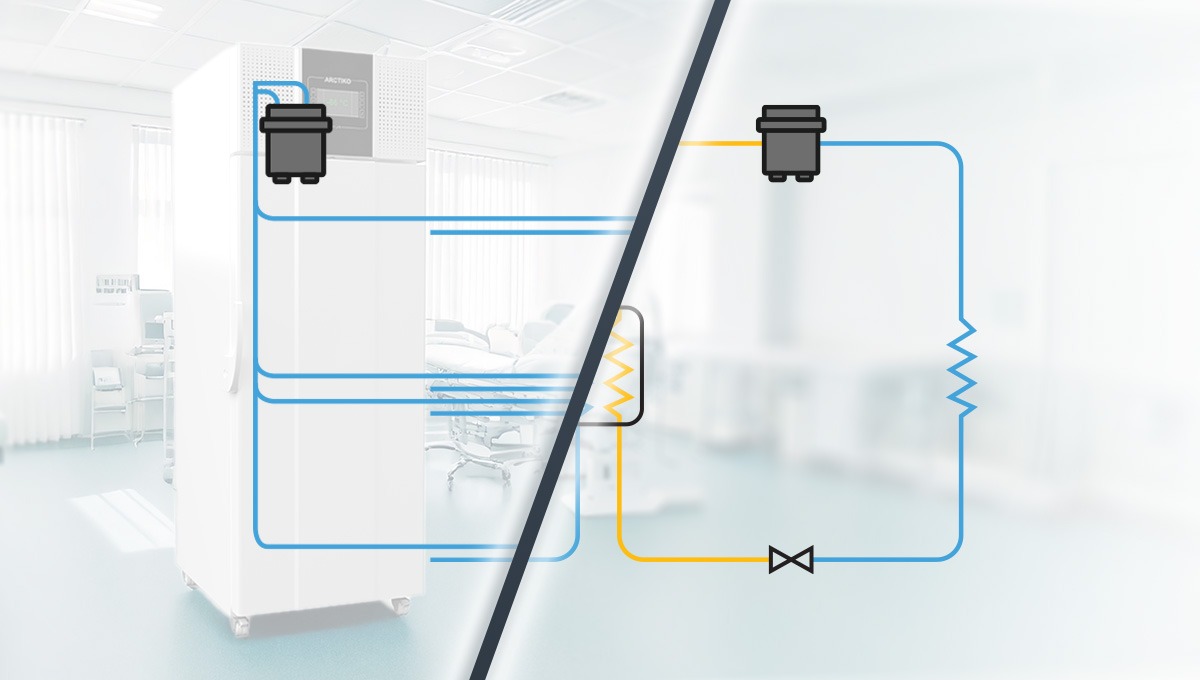
This technical whitepaper examines the cascade refrigeration system commonly used in ultra-low temperature (ULT) freezers and compares it with ARCTIKO’s TRUE DUAL™ cooling architecture, focusing on reliability, temperature uniformity, uptime and total cost of ownership in critical −80°C storage environments.
Cascade Refrigeration Systems and Alternative ULT Architectures
Ultra-low temperature (ULT) refrigeration is essential in life sciences, bio-banking, clinical diagnostics and research. While the cascade refrigeration system has been the standard approach for maintaining temperatures between −70°C and −86°C, ARCTIKO’s TRUE DUAL™ technology enhances reliability and uniformity through independent, redundant cooling circuits.
Technical Foundation: ULT Refrigeration System Architectures
Conventional Cascade Refrigeration Systems
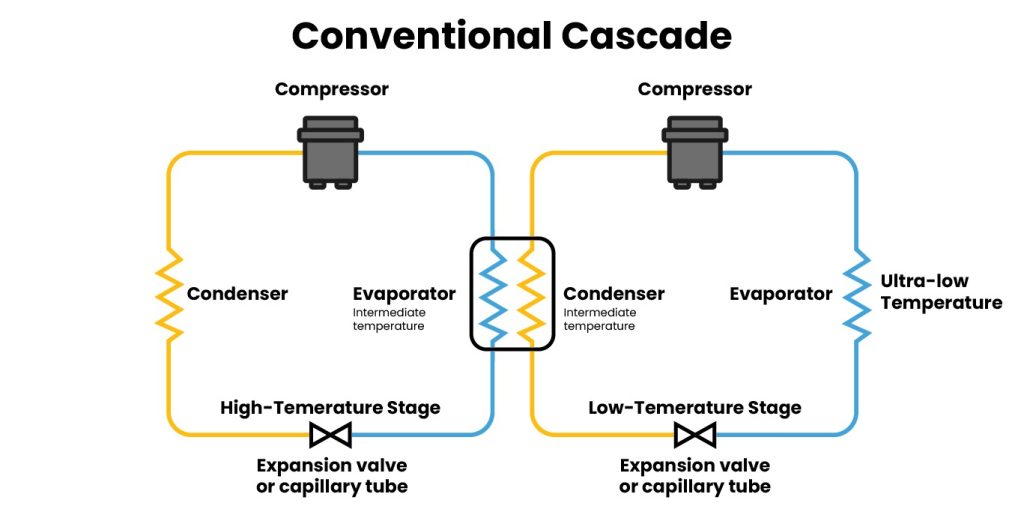
A cascade refrigeration system uses two cycles in series to reach ultra-low temperatures. Each stage uses a matched refrigerant; the high-temperature circuit rejects heat to the environment, while the low-temperature circuit is cooled. Both circuits must run together; any failure quickly raises the temperature and risks the safety of the sample.
ARCTIKO TRUE DUAL™ System Architecture
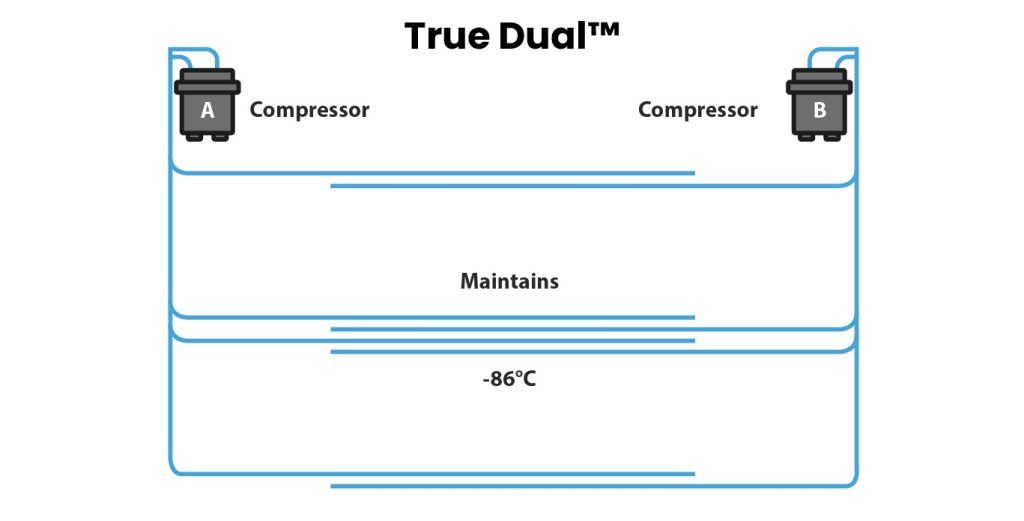
ARCTIKO’s TRUE DUAL™ system is fundamentally different from a cascade refrigeration system. Instead of two dependent stages, TRUE DUAL™ uses two separate cooling circuits, each with its own compressor. Each loop cools the cabinet directly, so if one circuit fails, the other continues to cool the cabinet. This built-in redundancy protects samples without needing outside backup.
Operational Benefits of Independent Cooling Architectures
Enhanced Sample Security and Redundancy
TRUE DUAL™ technology uses two independent cooling cycles, allowing the freezer to maintain temperatures at or below −70°C even if one system fails, helping to protect sample integrity. By contrast, cascade refrigeration systems can warm quickly if one stage fails, often requiring an immediate transfer of materials to backup storage. This built-in redundancy reduces reliance on an external backup unit, lowers the risk of sample loss or research disruption, and provides an added safety margin for critical biological materials such as cells, tissues, and reagents.
Because each TRUE DUAL™ loop operates independently, uptime is increased and the risk of unplanned outages is reduced, ensuring stable temperature control. Cascade systems, in comparison, are more vulnerable to a complete shutdown if a critical component malfunctions.
Performance Advantages in Ultra-Low Temperature Freezers
Fast Temperature Recovery and Improved Uniformity
In ultra-low temperature applications, TRUE DUAL™ systems cool each shelf directly, which improves chamber temperature uniformity and enables faster recovery following door openings.
Faster recovery reduces the duration of temperature excursions and limits thermal stress on stored materials. The use of balanced, independent cooling loops also distributes mechanical load more evenly across compressors and components, reducing wear over time and simplifying maintenance requirements.
In contrast, cascade refrigeration systems operate under sequential stage loading, which can result in higher mechanical stress and less uniform performance under variable demand conditions.
Economic and Lifecycle Considerations for ULT Refrigeration Systems
Total Cost of Ownership
TRUE DUAL™ can lower long-term costs by:
- Eliminating the need for redundant backup freezers
- Reducing emergency response and sample transfer costs
- Extending service intervals and component life
- Reducing energy penalties from constant pull-down recovery
By reducing downtime and system complexity, TRUE DUAL™ delivers long-term economic value in ultra-low temperature storage.
Simplified Maintenance and Lower Failure Risk
TRUE DUAL™ units have fewer failure points. Their design simplifies service and troubleshooting compared to cascade refrigeration systems, which require diagnosing multiple interdependent components.
Reliability in Critical Ultra-Low Temperature Storage Environments
Labs, biobanks and hospitals rely on ultra-low temperature refrigeration systems that meet strict compliance and performance standards. TRUE DUAL™’s redundancy ensures high uptime and supports risk mitigation, helping institutions meet reproducibility and traceability requirements. Regular temperature spikes can affect compliance, funding and safety, making robust system design essential for institutional buyers.
System-Level Differences in ULT Refrigeration
| Feature or Metric | TRUE DUAL™ System | Conventional Cascade System |
| Cooling loop redundancy | Built-in independent loops | Interdependent loops |
| Sample protection in failure | Maintains ≤−70°C | Temperature rises without intervention |
| Temperature uniformity | High (direct shelf cooling) | Moderate (dependent on stage balance) |
| Need for backup freezer | Not required | Often required |
| Maintenance Complexity | Lower | Higher |
| Time to temperature recovery | Faster | Slower |
Conclusion
ARCTIKO’s TRUE DUAL™ represents a shift in ultra-low temperature refrigeration system design. It enhances reliability, reduces operational risk and ensures stable temperatures in critical storage environments. For facilities where sample security and uptime are crucial, TRUE DUAL™ outperforms cascade refrigeration system designs. With focused redundancy, direct cooling and straightforward operation, laboratories and healthcare providers can achieve reliable performance with fewer operational obstacles.