
 Fast Delivery
  Global Compliance
  Long Term Support
Who Is This Guide For?
This guide is intended for blood bank and transfusion service managers, hospital and laboratory professionals, healthcare procurement teams and facilities responsible for cold chain management.
It is relevant across hospital blood banks, regional transfusion centres and specialist healthcare environments.
A Guide to Blood Bank Storage
Blood Bank Storage is a critical function within healthcare systems, ensuring that donated blood and blood components remain safe, viable and compliant from collection through to transfusion.
This guide provides a clear, standards-led overview of blood bank storage processes, temperature requirements, risks and equipment considerations. It is designed as a practical reference for healthcare professionals who require both technical accuracy and real-world application.
What Do Blood Banks Do?
Blood banks are responsible for the collection, testing, processing, storage and distribution of blood and blood components.
Their role is to ensure that every unit of blood remains safe, traceable and effective until it is required for transfusion. This includes managing storage conditions, monitoring temperature, controlling shelf life and ensuring compliance with healthcare regulations.
Safe and compliant storage underpins every stage of blood bank operations.
How Is Blood Stored Safely?
Blood is stored using medical-grade refrigeration and freezing systems designed specifically for healthcare use.
Safe blood storage relies on tight temperature control, uniform cooling throughout the cabinet, continuous monitoring with alarms and clear segregation of blood components.
Domestic or commercial refrigerators are not suitable for blood storage, as they cannot maintain consistent temperatures or meet regulatory requirements.
What Is the Required Temperature for Blood Storage?
Blood storage temperatures vary depending on the component being stored.
Blood must be stored between +2°C and +6°C, preferably +4°C, in medical-grade blood bank refrigerators. Platelets are stored between +20°C and +24°C and require continuous agitation. Plasma and cryoprecipitate must be stored frozen at –30°C or colder.
These temperatures must be maintained continuously, using certified equipment with monitoring and alarm systems in place.
Temperature stability is a regulatory requirement and a patient safety priority.

MDD and MDR Compliance
Blood bank storage equipment used in the UK and EU must comply with the Medical Device Directive (MDD) or the Medical Device Regulation (MDR).
These regulations classify blood bank refrigerators and freezers as medical devices, as they support the storage of blood and blood components for transfusion. MDD- and MDR-certified equipment is designed and tested to meet strict safety, performance and risk management requirements.
Selecting certified equipment supports regulatory compliance, audit readiness and patient safety, while non-certified systems can introduce unnecessary risk.
Plasma Storage Temperature Explained
Plasma must remain frozen to preserve clotting proteins.
If plasma warms above its specified storage temperature, protein degradation can occur and the unit may become unsuitable for transfusion.
Reliable freezing and long-term temperature stability are essential for plasma storage.
How Long Can Different Types of Blood Be Stored For?
The length of time blood can be stored depends on the blood component and the storage conditions.
Blood can typically be stored for up to 42 days when maintained between +2°C to +6°C (University Hospitals Sussex Pathology). Platelets can be stored for up to 7 days at +20°C to +24°C with continuous agitation. Frozen plasma can be stored for up to 12 months at –30°C or colder. Cryoprecipitate can also be stored for up to 12 months when frozen correctly.
These maximum storage times are only achievable when correct temperatures are maintained throughout the entire storage period.
What Is the Rule of 3 in Blood Banks?
The ‘Rule of 3’ is an informal industry concept used to summarise three critical principles that must always be maintained to ensure blood safety.
These principles are correct temperature, correct storage duration, and correct handling procedures.
If any one of these is compromised, the blood product may no longer be suitable for transfusion.
Blood Bank Equipment Requirements
Blood bank storage equipment must be purpose-built for healthcare environments.
Essential requirements include medical-grade certification, uniform temperature distribution, visual and audible alarms, continuous temperature monitoring and compatibility with backup power systems.
Equipment selection has a direct impact on compliance, reliability and operational confidence.
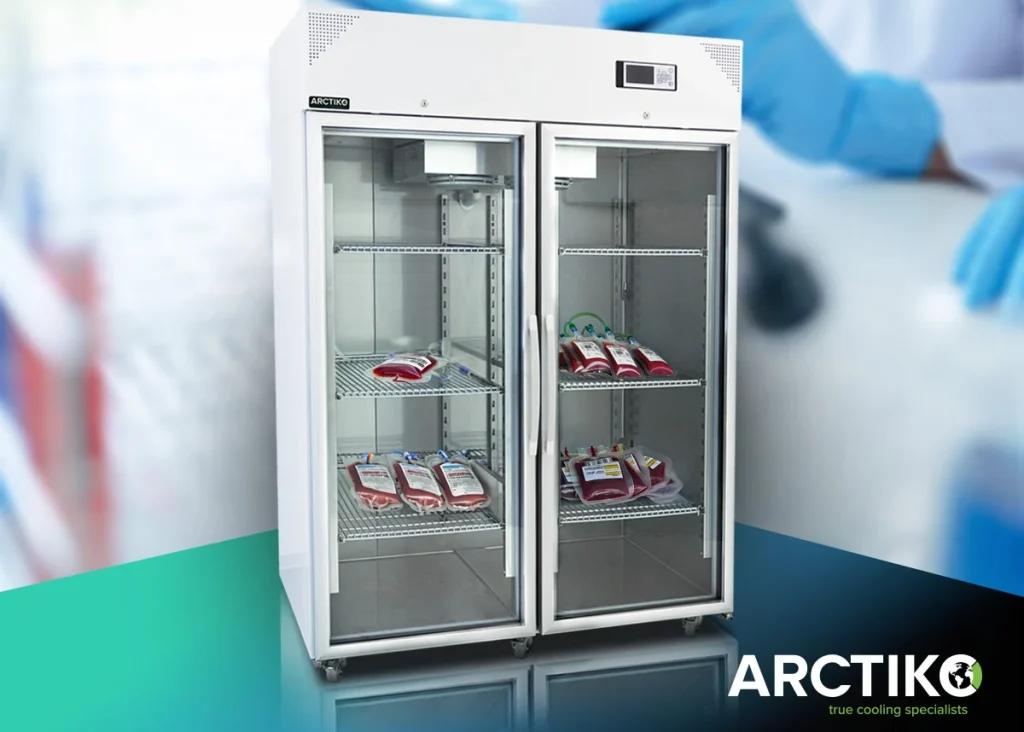
Blood Bank Refrigerator vs Standard Refrigerator
A blood bank refrigerator is fundamentally different from a standard refrigerator.
Blood bank refrigerators provide precise temperature control, forced-air circulation, integrated alarm systems and compliance with healthcare regulations.
Standard refrigerators cannot deliver the consistency, monitoring or documentation required for safe blood storage.
Equipment Solutions That Support Blood Bank Storage
Specialist equipment plays a key role in meeting storage standards and reducing operational risk.
Blood bank refrigerators are designed for blood and blood component storage, offering stable performance at +4°C, uniform airflow and integrated alarm systems.
Plasma and laboratory freezers support frozen blood components at –30°C and below, providing reliable long-term performance in regulated environments.
Ultra-low temperature freezers are used for specialised or extended storage needs, offering temperatures down to –86°C and increased safety margins for critical applications.
Temperature monitoring systems provide continuous data logging, alerts and audit-ready records, supporting traceability and compliance.
The right equipment reduces risk and supports regulatory confidence.